
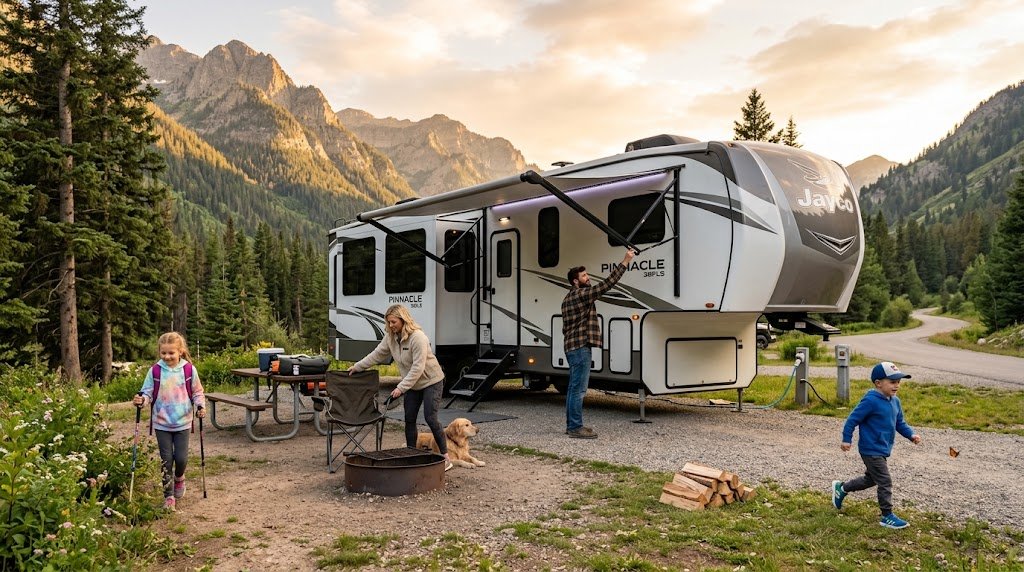
Can a Family Live in an RV? Here's What You Need to Know Before Deciding
Yes, families can and do live in RVs full-time across the United States. It is not a fringe lifestyle or a temporary experiment for most of the families who commit to it. Families with toddlers, school-age children, and teenagers have all built sustainable lives on the road. Whether it works for your family depends on realistic expectations, a well-chosen unit, financial stability before you leave conventional housing, and an honest look at what you are trading away alongside what you are gaining.
What Does Living in an RV as a Family Actually Look Like Day to Day?
Before the logistics, it helps to understand what the daily texture of this life looks like in practice, not in a highlight reel.
Mornings in a full-time family RV typically start the same way as any other morning: breakfast, getting children up and moving, and whatever schooling or work obligations the day holds. The difference is that a 300 square foot rig holds all of it simultaneously. The kitchen table becomes a schoolroom. The couch becomes an office. The space requires more intention than a house simply because there is no extra room to absorb disorder.
Afternoons often involve outdoor time, which is one of the strongest arguments for the lifestyle. Full-time RV families almost universally spend more time outside than they did in a fixed home, which benefits children particularly. Hiking, exploring new places, swimming, and campground socializing fill the hours that would otherwise be spent in cars, scheduled activities, and after-school logistics.
Evenings are compact and close. Families share a small space for dinner, wind-down, and sleep. For some families that closeness becomes one of the things they love most about the lifestyle. For others it is the adjustment that never quite becomes comfortable.
The gap between those two experiences usually comes down to one thing: the right unit. A family crammed into a rig too small for their number of people will struggle regardless of how committed they are to the lifestyle.
What Are the Real Benefits of Living in an RV as a Family?
The families who sustain this lifestyle for years tend to cite the same core benefits, and most of them have nothing to do with scenery.
Time together changes. Full-time RV families report a fundamentally different relationship with daily time. The commute disappears. After-school activity schedules simplify. The family eats together, travels together, and experiences new things together at a frequency that is difficult to achieve in a conventional schedule. That compounded time is something most families only appreciate after they have had it.
Children's learning expands. Roadschooling, homeschooling curricula, and the experiential education of visiting national parks, historical sites, and communities across the country develop a kind of curiosity and adaptability in children that structured classroom environments rarely produce to the same degree.
Cost of living can drop significantly. For families coming out of high-rent markets, the comparison is often stark. Eliminating a mortgage or rent payment and replacing it with campground fees, fuel, and RV costs frequently results in a lower monthly number, particularly for families who had been spending significantly on housing. That calculation varies considerably based on how often you move, what kind of campgrounds you use, and your RV's operating costs.
Simplicity becomes a value. Life in an RV leaves no room for accumulation. Families who have lived this lifestyle describe a clarity that comes from needing less and using what they have. Children raised in this environment tend to develop a different relationship with material things than their peers.
Flexibility is real. Seasonal camping in Montana's mountains in summer and warmer destinations in winter is a practical option when your home has wheels. Families are not anchored to a school district, a lease renewal date, or a neighborhood.
What Are the Honest Challenges of Family RV Living?
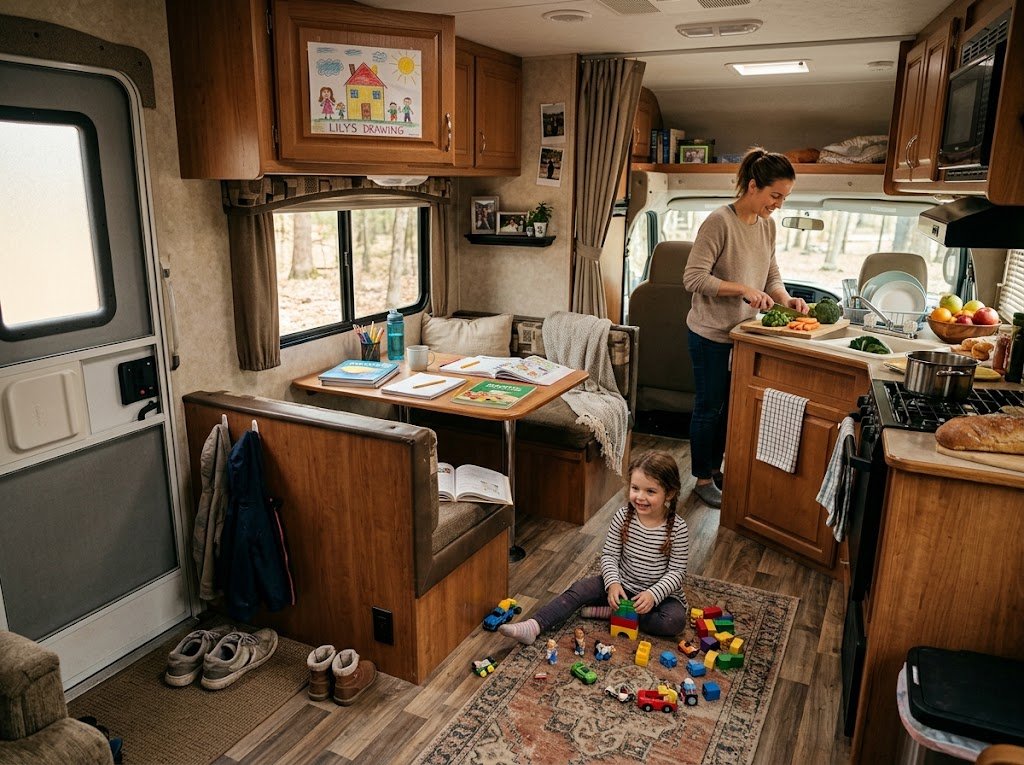
A balanced view requires equal honesty about the difficulties. The families who prepare for these challenges do better than those who expect the lifestyle to solve problems on its own.
Space is the first and most persistent constraint. Adults who have always had a room to retreat to will find the adjustment harder than children do. Privacy is limited by design. Arguments happen in small spaces with no exit. Families who succeed figure out how to give each person some version of a defined personal space and some version of time alone, even if it just means sitting outside while others are inside.
Income has to be solved before you leave. The RV lifestyle does not generate income. Families who leave conventional employment without a reliable remote income source, business, or substantial savings often find themselves returning to a fixed address within a year. The financial failure mode of this lifestyle is very predictable: underestimating costs and overestimating how quickly remote income can be established.
Healthcare requires planning. Without employer-provided coverage, families need to find and maintain their own health insurance. ACA marketplace plans are the most common solution, with plan selection based on the domicile state and careful attention to how each plan handles out-of-network care across different states.
Schooling requires consistency. Homeschooling is legal everywhere, but it also requires a parent who is willing to take it seriously. Curriculum, scheduling, and accountability all fall on the family. Families who underestimate the time and commitment involved in homeschooling multiple children while also managing daily life in a small space are the ones who struggle most with this aspect.
Maintenance is constant. A unit used full-time accumulates wear at a rate that seasonal campers never experience. Roof seals, tires, slide mechanisms, water systems, and appliances all require attention on a schedule that does not leave much margin for procrastination when the rig is your home.
Social connection takes effort. Sustained friendships require intentionality when your address changes every two weeks. Full-time RV families build community through online networks, gatherings of other traveling families, and returning to favorite campgrounds seasonally. Children can struggle more than adults with the lack of consistent peer relationships, and this is worth having an honest conversation about before you commit.
What Kind of RV Does a Family Actually Need?
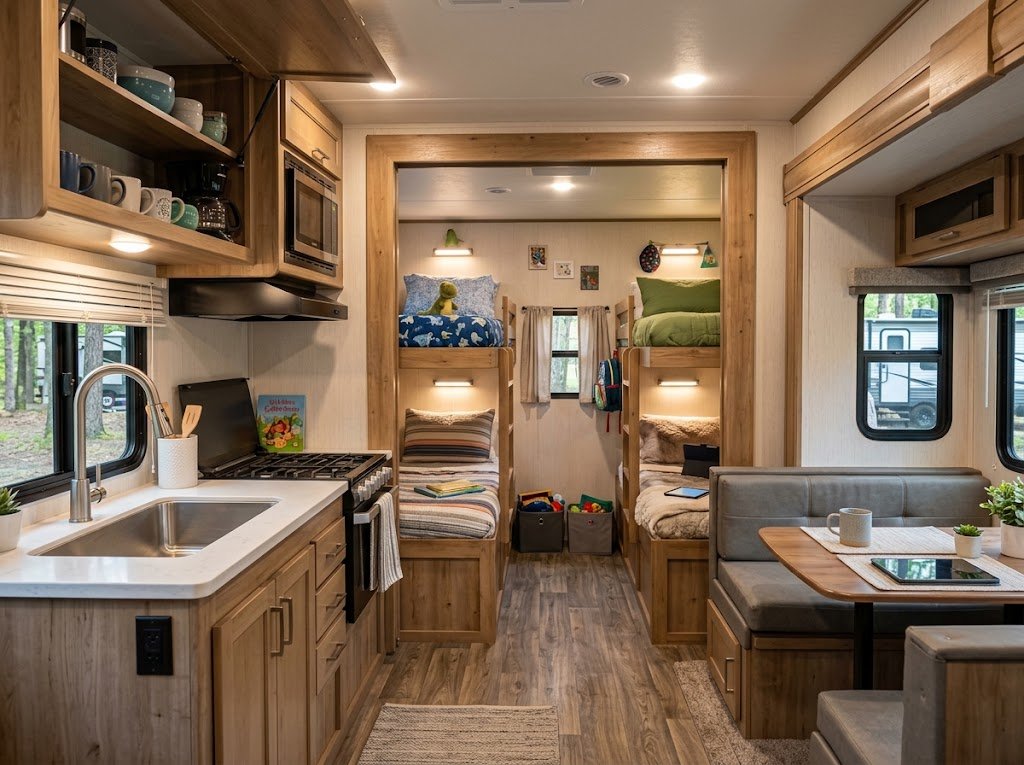
This is the decision that shapes everything that follows. The wrong unit creates problems that no amount of organization, positive attitude, or routine can fix.
For families with two or more children, the minimum practical starting point is a unit with a dedicated bunk room that keeps children's sleeping area separated from the main living space. A full interior bathroom is equally important. Sharing a campground bathhouse for every family member's daily hygiene needs is manageable on a camping trip and exhausting as a permanent arrangement.
Fifth wheels are the most popular choice among full-time families. The raised front section creates a genuine master bedroom with a door, giving parents private space that no other towable configuration provides. Brands like Alliance RV, Keystone, and Forest River all produce fifth wheel lines with bunkhouse configurations built for family living. A fifth wheel requires a heavy-duty pickup truck with a properly rated fifth wheel hitch, which adds to the overall cost but justifies itself in livability.
Bunkhouse travel trailers are the most accessible entry point for families in terms of price and tow vehicle requirements. Coachmen, Forest River, and Prime Time each produce bunkhouse models specifically sized and configured for families, with full kitchens, dedicated bunk rooms, and enough storage for long-term daily use.
Class A motorhomes offer the most living space of any RV type and a true residential feel. They eliminate the need for a separate tow vehicle, though families often tow a small car behind them for local errands and day trips. Class C motorhomes are a more approachable all-in-one option, easier to drive than a Class A and typically more affordable while still providing solid family living space.
Families coming from a larger home sometimes underestimate how much the right floor plan matters at the outset. Spending time walking multiple units in person before deciding is consistently the advice of full-time families who have already made the transition. You can browse the Pierce RV inventory online, but floor plans read very differently once you are standing inside them.
Is Living in an RV Cheaper Than a House for Families?
The comparison is real but not simple. For families coming out of expensive housing markets, the savings can be significant. For families in lower-cost areas or those who travel frequently and use premium campgrounds, the cost differential narrows.
Monthly expenses in full-time RV living typically include campground fees, fuel, RV insurance, propane, health insurance, food, phone, internet, and a maintenance fund. The campground fees replace rent or a mortgage payment. The maintenance fund is the expense most families fail to budget adequately and the one that creates the most financial stress when ignored.
The clearest scenario where RV living reduces family expenses is when a significant mortgage or rent payment is eliminated and replaced by campground fees that cost less per month. The clearest scenario where it does not save money is when families move frequently, fuel costs accumulate, and maintenance issues arise without an emergency fund to cover them.
Financing your RV brings a monthly payment into the equation that should be factored against the housing cost it replaces. Pierce RV's financing team works with multiple lenders to match buyers with terms that fit their actual budget. If you currently own an RV and want to upgrade to a unit better suited for full-time family use, the trade-in program applies your current unit's value toward the purchase. The specials page and deal of the week are worth checking for value-priced family-ready units.
What Should a Family Ask Before Making the Decision?
These questions are worth sitting with for longer than a weekend before committing.
Do we have reliable income that does not depend on being in a fixed location? This is the single most important factor in long-term success.
Have all adults honestly evaluated how they feel about shared small-space living for an indefinite period? This lifestyle requires genuine comfort with proximity, not just enthusiasm for travel.
Have we talked to our children about what changes and what doesn't? Children who are included in the decision and given realistic information adjust better than those who are surprised by the reality.
Do we have a domicile state selected and legal requirements understood? South Dakota, Florida, and Texas are the most common choices for full-time travelers because of their straightforward registration processes and income tax situations.
Have we walked multiple floor plans in person and identified the minimum space our family needs to function comfortably? Not what looks exciting in photos but what we can actually live in every day.
Do we have a plan for maintenance and a service relationship with a dealership we trust? The Pierce RV service department and parts department serve families across Montana and provide the kind of ongoing support that makes full-time RV living sustainable over years rather than months.
How Pierce RV Can Help Your Family Decide
Pierce RV works with families at every stage of this conversation, from early explorers still asking whether this is even possible to committed buyers who know exactly what they need. Our team has helped many Montana families work through the floor plan question, the financing question, and the trade-in question.
Browse new RVs and pre-owned RVs across fifth wheels, travel trailers, and motorhomes in our full inventory. When you're ready to talk through options, contact our team or visit us in Montana.
Frequently Asked Questions
Can a family with young children live in an RV full-time?
Yes. Families with infants, toddlers, and young children live in RVs full-time. The keys are choosing a unit with a full interior bathroom, a dedicated sleeping area for children, and enough kitchen space for daily cooking. Young children typically adapt faster than adults to life in a smaller space. Establishing clear campsite rules and a predictable daily routine gives young children the structure they need regardless of where the RV is parked.
How big of an RV does a family of four need to live in full-time?
Most families of four find that a fifth wheel or a large bunkhouse travel trailer in the 32 to 42 foot range provides a workable amount of space for full-time living. A dedicated bunk room, a full bathroom, and a proper kitchen are the non-negotiable features. Parent privacy is significantly better in a fifth wheel due to the elevated separate bedroom section. Families who try to full-time in a unit that is too small are the most common source of stories about the lifestyle not working out.
What do families do for income while living in an RV?
Remote employment is the most common income solution. Many full-time RV families work in technology, marketing, writing, consulting, customer service, or other fields where a laptop and reliable internet are sufficient infrastructure. Online businesses, freelance work, and seasonal employment at campgrounds and resorts are other common paths. Families who establish stable income before leaving conventional housing are the ones who sustain the lifestyle long-term.
Is full-time RV living safe for a family?
Yes, with the same common-sense precautions that apply to any living situation. RV parks generally have low internal speed limits, campground hosts, and a community culture where neighbors watch out for one another. The specific safety considerations with young children are vehicle traffic within the park, electrical pedestals at hookup sites, campfires, and water. Establishing clear campsite rules before arrival addresses most of the relevant risks. Buying from a dealer with a strong service department ensures that the rig itself stays in safe mechanical condition.
How do families handle laundry while living in an RV?
Families without an in-unit washer and dryer build campground laundromat visits into their weekly schedule, typically combining laundry with town errands once a week. Many full-time families consider washer and dryer prep or a combination washer/dryer unit one of the most important features to prioritize when choosing a new RV for full-time use, because the convenience over months and years of daily use adds up considerably.
Can a family live in an RV on a tight budget?
Yes, but with clear-eyed planning. The most accessible path for budget-conscious families is a quality used RV with the right floor plan, lower campground fees achieved through state park stays and BLM land, and a consistent maintenance schedule that prevents small issues from becoming expensive ones. The specials page and deal of the week regularly feature family-sized units at value pricing. The Pierce RV financing team can also help match monthly payments to what your budget can realistically carry.
Final Takeaway
Families can absolutely live in an RV, and thousands of them are doing it right now. The lifestyle rewards preparation more than enthusiasm. The right unit, reliable income, a realistic picture of the challenges, and a clear-eyed look at what your family actually needs in a living space are what determine whether this works for a year or for a decade.
Pierce RV carries new and pre-owned fifth wheels, travel trailers, and motorhomes suited to families considering full-time living. Our financing team will find terms that fit your budget. Our service department keeps your rig road-ready long after the sale. Contact us or visit our Montana dealership to start the conversation.
