
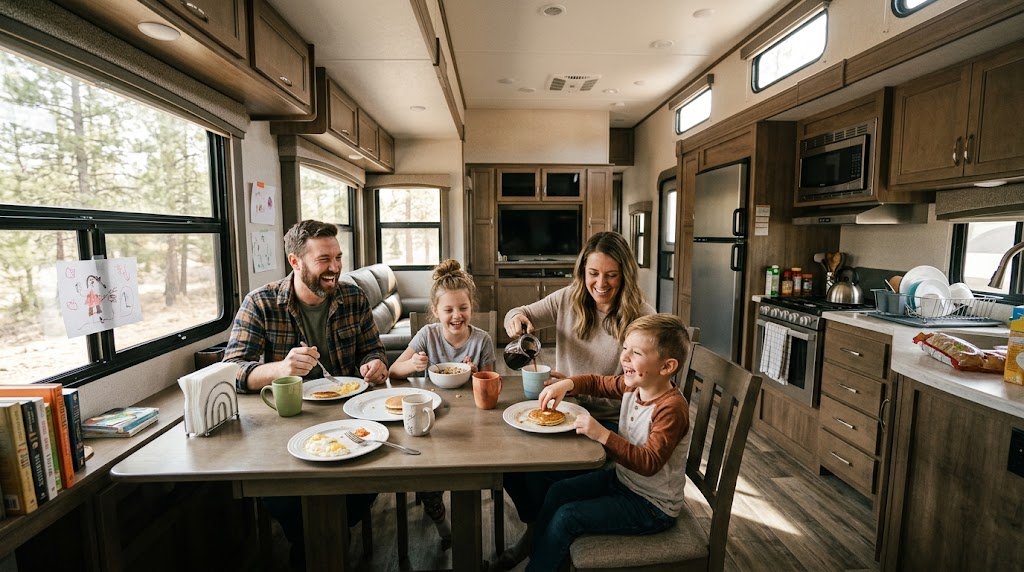
How to Live in an RV with a Family: A Practical Guide
Living in an RV with a family requires planning across several areas: choosing the right RV with enough space, establishing daily routines, managing schooling, handling finances and legal domicile, and maintaining the rig. Families who succeed in this lifestyle are the ones who go in with realistic expectations, a well-chosen unit, and a few solid systems in place before they leave the driveway.
What Does Full-Time RV Family Life Actually Require?
Living in an RV with children is fundamentally different from weekend camping trips. The excitement of novelty fades after the first few weeks, and what sustains the lifestyle long-term is intentional structure.
Families who make it work consistently share a few traits. They chose a unit with enough space and the right floor plan for their family size. They built routines that keep children anchored to a predictable rhythm even when the landscape outside changes week to week. They sorted out their finances and income before cutting ties with conventional housing. And they went in with honest expectations about what it actually feels like to share a small space with young children around the clock.
If you are still in the planning phase, two investments pay off more than any other: time spent talking to families already living this lifestyle, and time spent walking several different floor plans in person before you commit to one.
How Do You Choose the Right RV for Full-Time Family Living?
The RV you use for occasional camping is rarely the right unit for full-time living. This decision deserves more time and attention than almost any other part of the process.
For most families, a fifth wheel or a large bunkhouse travel trailer is the strongest starting point. Both offer dedicated sleeping areas for children, enough kitchen and bathroom space for genuine daily use, and storage that can hold a family's belongings without feeling impossibly cramped.
Fifth wheels create a split-level design that puts the master bedroom in a raised section at the front, giving parents meaningful privacy that is very difficult to achieve in any other towable configuration. They require a properly equipped pickup truck with a fifth wheel hitch, but the livability payoff is significant. Alliance RV, Keystone, and Forest River all produce well-regarded fifth wheel lines built with family-oriented floor plans.
Bunkhouse travel trailers are the most accessible entry point for families in terms of price and tow vehicle requirements. Manufacturers like Coachmen, Forest River, and Prime Time build bunkhouse models specifically designed for family living, with full bunk rooms, residential kitchens, and bathrooms sized for real daily use.
Motorhomes suit families who prefer an all-in-one setup without managing a separate tow vehicle. Class A motorhomes offer the most living space and the most residential feel of any RV type. Class C motorhomes are a more approachable option for families new to driving a larger vehicle, with solid space and a lower entry price than most Class A units.
Features worth prioritizing for full-time family use:
A full interior bathroom, which eliminates nighttime bathhouse trips with young children entirely
A dedicated bunk room or clearly separated sleeping area for kids
A residential-style kitchen with a full-size refrigerator if your budget allows
Washer and dryer hookups or a combination washer/dryer unit
Generous exterior storage bays for tools, gear, and seasonal items
Quality HVAC, because temperature control matters far more in a full-time rig than in a weekend camper
If you are unsure which type fits your family best, contact the Pierce RV team before you decide. Walking floor plans in person changes perspective in ways photos and floor plan diagrams simply cannot.
How Do You Set Up Daily Life Inside an RV?
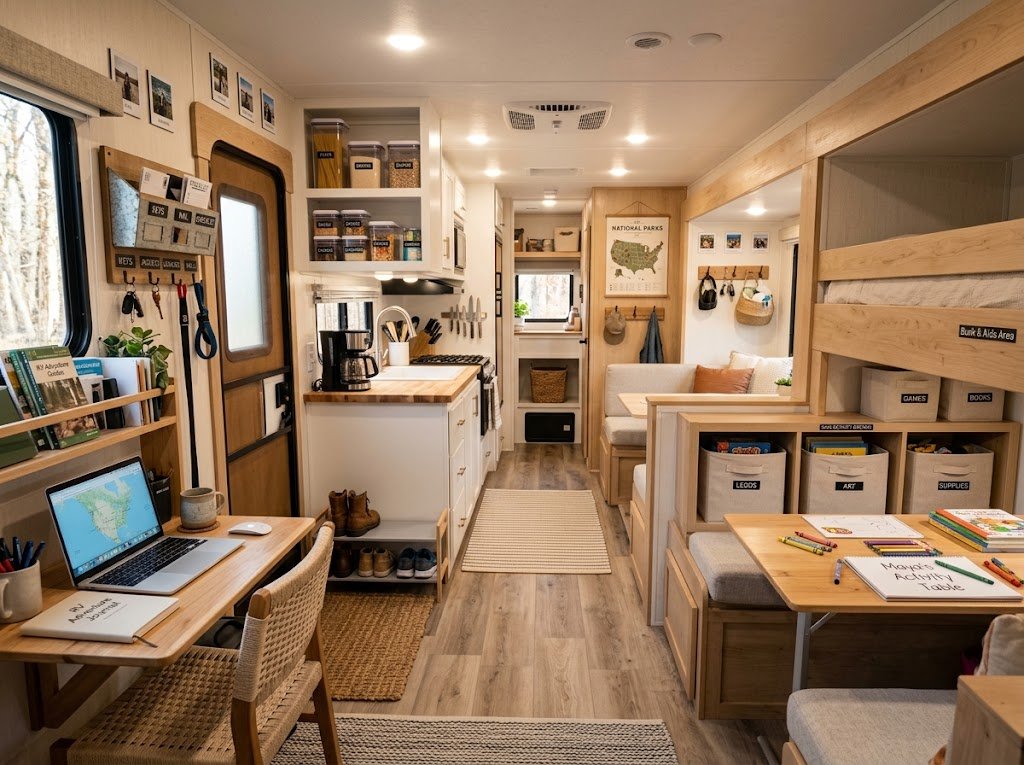
Getting daily routines right is what separates families who love this lifestyle from those who burn out within the first year.
Organization is the foundation of everything. In a space with limited square footage, every item needs an assigned home. Clutter builds up in an RV faster than in a house because there is no space to absorb it. Before moving in, go through every item your family plans to bring and evaluate whether it earns the space it takes up. Most families who have done this successfully report they brought far too much and pared down considerably after their first month on the road.
Meal planning takes adjustment. RV kitchens have less counter space and smaller refrigerators than a house kitchen. Families who plan meals weekly and shop accordingly use their kitchen far more efficiently. A quality propane grill outside the rig extends your cooking options and keeps heat out of the interior during summer months, which matters in a small space with children.
Laundry requires a system. Families without an in-unit washer and dryer build campground laundromat visits into their weekly schedule. Many full-timers combine laundry day with a town errand run once a week. Units with washer/dryer prep or combination units simplify the routine significantly.
Work-from-the-road families need reliable internet more than almost anything else. Cell boosters, mobile hotspots, and satellite internet services have improved dramatically and make remote work from an RV realistic in most parts of the country. Designating a specific work area inside the rig, even a compact fold-down desk, helps maintain the mental boundary between work hours and family time.
Children need defined personal space even in a small footprint. A bunk room gives kids a sense of ownership and a place to decompress. Individual reading lights, personal storage bins, and a small activity area in the living space make a real difference in how settled children feel in the rig.
How Do You Handle Schooling for Children Living in an RV?
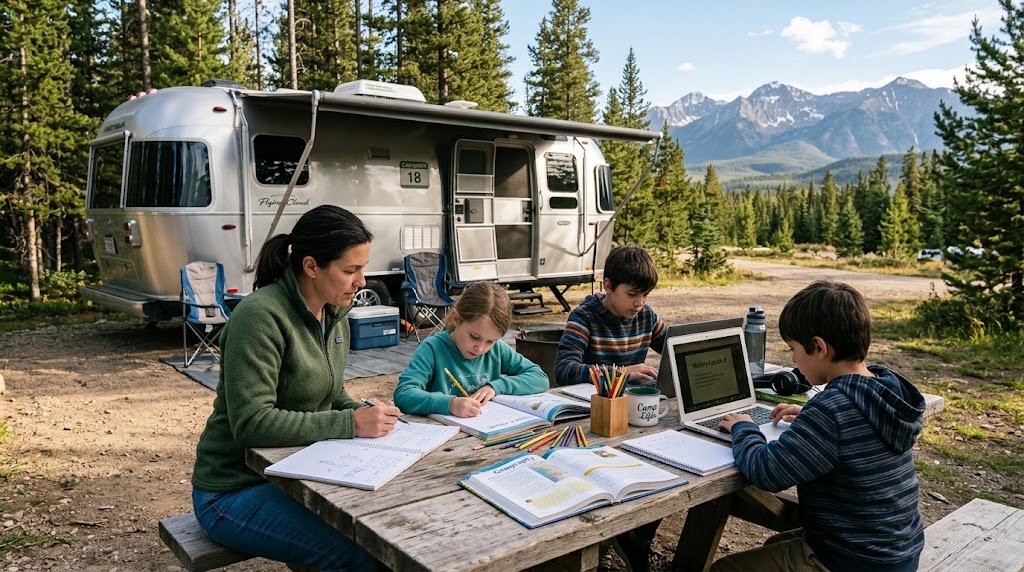
Schooling is the question most families raise first, and the answer is more manageable than many expect going in.
Homeschooling is legal in all 50 states and is the primary solution for the majority of full-time RV families. Most families register under their domicile state's homeschooling laws, which apply regardless of where the family is physically traveling. South Dakota, Florida, and Texas have particularly streamlined homeschooling requirements and are already popular domicile choices among full-timers for registration and tax reasons.
Accredited online schools offer a structured alternative with official transcripts and grade-level curriculum. Several programs are state-accredited and designed specifically to accommodate flexible scheduling, which suits life on the road well.
Roadschooling blends formal academics with the educational value that travel naturally provides. National parks become science and history classrooms. Local communities become geography and cultural studies. Families who embrace this approach consistently report that their children develop a genuine curiosity about the world that a fixed classroom rarely produces to the same degree.
How Do Families Manage Money While Living in an RV?
Financial planning before you leave conventional housing is not optional. Families who run the numbers carefully before committing avoid the most common reason people return to a fixed address: running out of money because actual costs were higher than anticipated.
Monthly costs to plan for include campground fees, fuel, propane, RV insurance, health insurance, food, phone, internet, and a maintenance and emergency fund. That maintenance fund is the item most families underestimate. Full-time RVs experience significantly more wear than recreational units, and small maintenance issues become large ones when you are living inside the rig daily.
Income for full-time RV families most commonly comes from remote employment, freelance work, online businesses, or seasonal work at campgrounds and resorts. Families who arrange reliable income before leaving are the ones who sustain this lifestyle for years rather than months.
Financing your RV is worth discussing early in the process. The Pierce RV financing team works with multiple lenders to match buyers with monthly terms that fit their actual budget, not just the purchase price. If you already own an RV and want to upgrade to a unit better suited for full-time living, the trade-in program applies your current unit's value toward a new purchase. You can also check current specials and the deal of the week for rotating pricing on family-friendly models.
What Are the Biggest Adjustments for Families?
Space and privacy are the most immediate challenges. Adults accustomed to having rooms to retreat to find the transition more difficult than children do, who typically adapt faster. Giving each family member a clearly defined personal space inside the rig, even something as small as a designated seat or storage bin, reduces the friction that comes from feeling constantly on top of each other.
Social connection takes more intentional effort than it does in a fixed neighborhood. Full-time RV families build community through online groups, campground friendships, and gatherings of other traveling families. Children who travel full-time often develop social confidence quickly because they meet new people constantly, but they still need consistent relationships to maintain.
Seasonal planning matters more than most families anticipate before starting. Montana winters are not hospitable full-time RV camping conditions without a well-insulated rig and careful campground selection. Many families develop a loose seasonal circuit, moving toward warmer or lower-elevation destinations in winter and back north or to mountain camps in summer.
How Do You Keep a Full-Time RV Well-Maintained?
A unit used year-round full-time accumulates wear far faster than one used on weekends. Staying ahead of maintenance is what keeps small issues from becoming expensive problems that disrupt daily family life.
Roof seals and caulking should be inspected at least twice a year. A small roof leak in a full-time rig causes damage and mold far faster than it would in a seasonal camper sitting in storage for months at a time.
Tires should be replaced on a schedule based on age and mileage, not on visible wear alone. Full-time rigs cover more miles and carry more consistent load than recreational units used occasionally.
Slide mechanisms need regular lubrication and periodic inspection. They cycle in and out far more frequently on a full-time rig and are among the most commonly serviced components.
Fresh water and wastewater systems require regular sanitizing and attention to connections and seals. Full-time use means full-time demand on systems that a weekend camper might cycle through once a month.
The Pierce RV service department handles maintenance and repairs across the brands we carry. The parts department stocks components for models in our inventory and can source parts for a wide range of units. Buying from a dealer with an in-house service team means you have reliable support after the purchase rather than hunting for a qualified technician at each stop. Pierce RV also offers RV storage for families who need a secure option between trips or during an extended seasonal stay.
How Pierce RV Can Help Your Family Get Started
No amount of planning, organization, or routine-building makes up for an RV that doesn't have the right floor plan or enough space for your family's actual needs. The unit itself is the foundation.
Pierce RV carries a wide selection of new and pre-owned RVs across fifth wheels, travel trailers, and motorhomes. Our team has helped many Montana families find a unit that genuinely fits the way they want to live. Browse the full inventory, explore financing options, or contact our team to start the conversation.
Frequently Asked Questions
How much does it cost to live in an RV as a family?
Monthly costs vary widely depending on your RV, how often you move, and your lifestyle choices. Common ongoing expenses include campground fees, fuel, propane, RV insurance, health insurance, food, phone, internet, and a maintenance fund. Most full-time families find their total monthly expenses comparable to or lower than their previous housing costs, particularly once a mortgage or rent payment is removed from the equation. Budgeting for maintenance and unexpected repairs before you leave prevents the financial stress that causes many families to return to conventional housing prematurely.
What is the best RV for a family of four living full-time?
A bunkhouse fifth wheel or a large bunkhouse travel trailer is the most practical choice for a family of four. Both provide dedicated sleeping space for children, a full bathroom, and enough kitchen area for daily cooking. Fifth wheels add the benefit of genuine bedroom separation for parents. Class C motorhomes are a strong option for families who prefer an all-in-one unit without managing a separate tow vehicle.
How do children adapt to living in an RV full-time?
Most children adapt faster than their parents expect. Younger children in particular tend to thrive with the consistency of close family proximity and the novelty of new places. Older children and teenagers do best when they have a clearly defined personal space within the rig, even if it's just a bunk with their own light and storage. The biggest single factor in how well children adjust is how their parents approach the lifestyle. Kids take cues from parental stress or excitement more reliably than from the square footage.
Is it hard to maintain an RV used full-time?
It requires more attention than a weekend camper, but it is entirely manageable with a consistent schedule. The key areas are roof seals, tires, slide mechanisms, water systems, and battery and electrical systems. Full-time rigs cycle through significantly more use than recreational units, so staying ahead of maintenance is what keeps small issues from becoming expensive ones. Having a reliable service department you trust makes this considerably easier than handling everything independently from the road.
Can you work remotely while living in an RV with a family?
Yes, and many full-time RV families support themselves entirely through remote work. Cell boosters, mobile hotspots, and satellite internet have made reliable connectivity realistic in most areas of the country. Designating a specific work area inside the rig and establishing clear boundaries around work hours helps maintain the separation between professional responsibilities and family time that is harder to achieve when both happen in the same small space.
Should I buy new or used for full-time family RV living?
Both can work well depending on your budget and priorities. A new RV provides manufacturer warranty coverage and lets you choose the exact floor plan and features your family needs. A well-maintained used RV from a reputable brand at a lower purchase price is also a strong option, particularly when it comes from a dealer who has inspected and serviced it. Checking the current specials page is worthwhile for certified pre-owned units that combine reliability with value-oriented pricing.
Final Takeaway
Living in an RV with a family is entirely achievable for families who plan carefully and choose the right unit from the start. The right RV, a workable schooling approach, a realistic budget, and honest conversations about the adjustments ahead are what separate families who thrive from those who turn back after a few months.
Pierce RV carries new and pre-owned fifth wheels, travel trailers, and motorhomes suited to families planning full-time life on the road. Our financing team will help you find terms that match your actual budget. Our service department keeps your rig road-ready long after the purchase. Contact us to start the conversation about which unit fits your family's plan.
