
What is the best RV for a family of 5
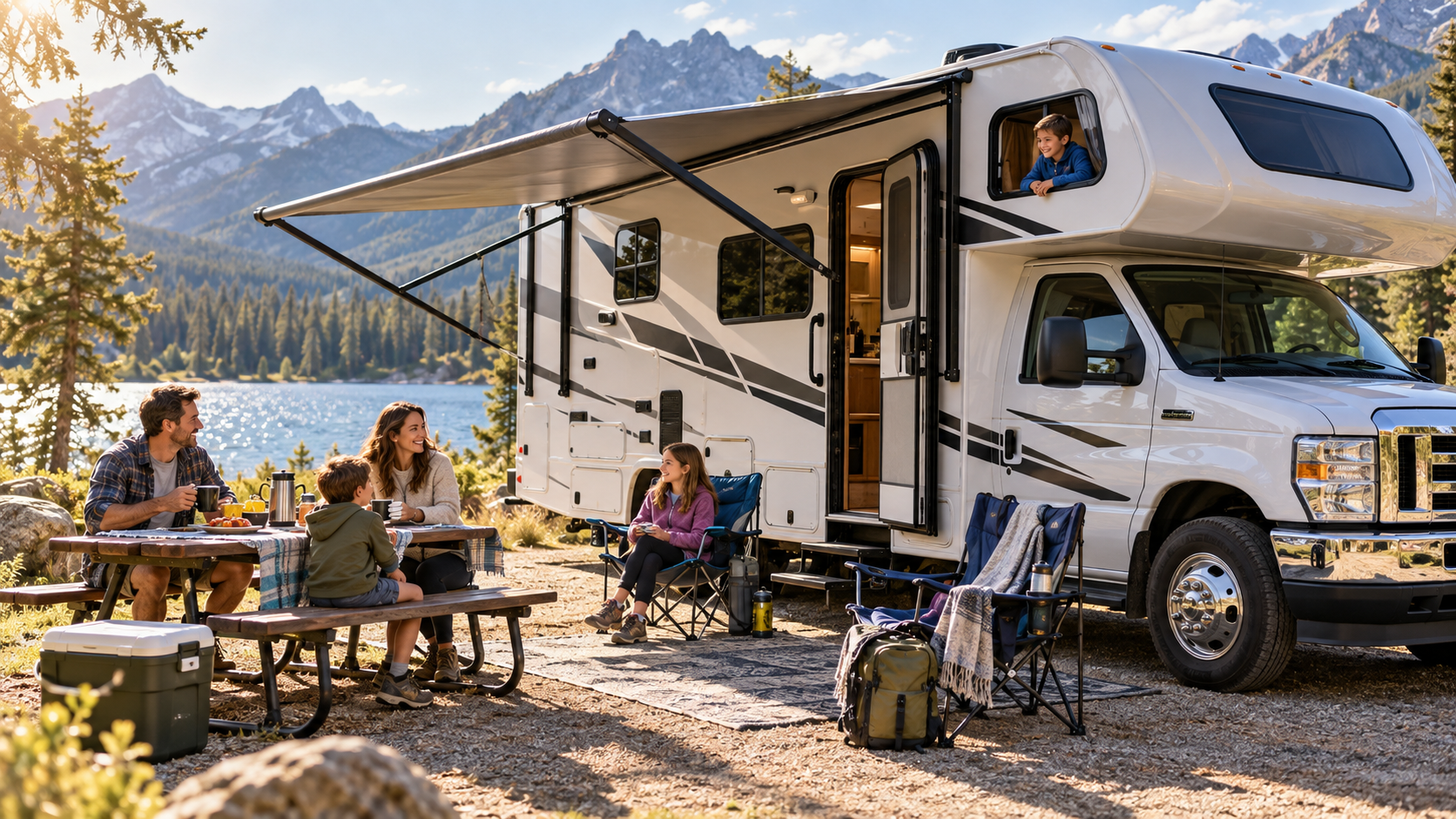
The best RV for a family of 5 is usually a bunkhouse travel trailer or a bunkhouse fifth wheel. Both give the kids their own sleeping area, separate from the main bedroom, while keeping the price and towing needs within reach for most families. If you'd rather drive than tow, a Class C motorhome is the top choice, as long as it has five belted seating positions for travel.
Which RV Type Works Best for a Family of Five?
For most families of five, a bunkhouse travel trailer offers the best balance of space, price, and flexibility. Families who camp often or for long stretches tend to be happier in a bunkhouse fifth wheel, and families who want to skip towing should look at Class C motorhomes.
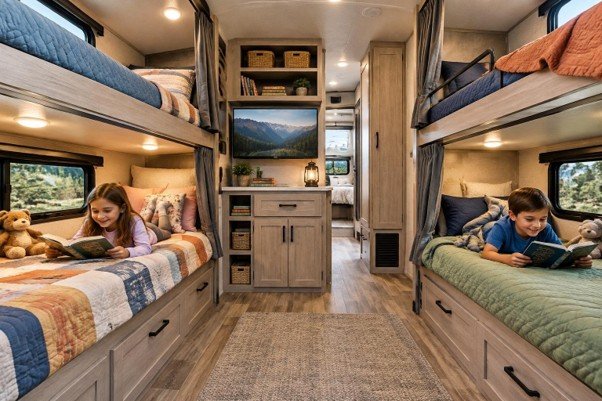
The deciding factor is almost always sleeping arrangements. Five people means at least three kids or two adults plus three others, and a layout that relies on converting the dinette and couch every night gets old fast. A dedicated bunk room lets the kids go to bed while parents stay up, and it keeps gear and clutter out of the main living area.
Here's how the main RV types stack up for a larger family.
Bunkhouse Travel Trailers
A bunkhouse travel trailer has a separate bunk area, usually in the rear, with two to four bunks. The master bedroom sits at the opposite end.
Pros:
Lower purchase price than most fifth wheels and motorhomes
Wide range of lengths and weights
Many models can be towed with a properly equipped half-ton truck or large SUV
Unhitch at camp and use your tow vehicle for day trips
Cons:
Longer units can be harder to tow in wind and on mountain grades
Less storage than a comparable fifth wheel
Passengers cannot ride in the trailer while it's moving
Best for: First-time RV families, weekend campers, and families working with a moderate budget.
Browse our travel trailers for sale and look for floorplans with "BH" in the model name, which usually signals a bunkhouse layout. You can also narrow your search to new travel trailers or used travel trailers.
Bunkhouse Fifth Wheels
A fifth wheel connects to a hitch in the bed of a pickup truck. The raised front section typically holds the master bedroom, which frees up space for a larger living area and a roomier bunk room in the rear.
Pros:
More living space and higher ceilings
More stable and easier to tow than a travel trailer of the same length
Bigger bunk rooms, and some floorplans add a second bathroom or a loft
Better suited for long trips and extended stays
Cons:
Requires a pickup truck, often a three-quarter-ton or larger
Higher purchase price
The truck bed is mostly taken up by the hitch
Best for: Families who camp often, take long summer trips, or want more room to spread out.
See our current fifth wheels for sale, or compare new fifth wheels and used fifth wheels. As with travel trailers, a "BH" in the model name usually points to a bunkhouse floorplan.
Class C Motorhomes
A Class C motorhome is built on a truck or van chassis and has a recognizable over-cab bunk. Many family-oriented Class C floorplans combine that cab-over bunk with a rear bed and a convertible dinette.
Pros:
No tow vehicle needed
Kids can use the bathroom or grab a snack at a rest stop without unpacking
Easier to drive than a Class A for most people
Can tow a small car for day trips
Cons:
Engine and chassis maintenance on top of the living quarters
Higher cost per square foot of living space
Not every seat is belted, so seating capacity may be lower than sleeping capacity
Best for: Families who travel long distances, move campsites often, or don't want to tow.
Explore Class C motorhomes and the larger, heavier-duty Super C motorhomes if you need more room or towing capacity. Budget-minded families can also check used Class C motorhomes.
What About Toy Haulers, Class A, and Class B RVs?
Toy haulers can work well for active families. The rear garage often converts to a sleeping area with fold-down beds, and it doubles as space for ATVs, bikes, or kayaks. View our toy haulers if your family hauls gear.
Class A motorhomes offer the most interior space of any drivable RV, but they're the largest and most expensive option. Browse Class A motorhomes if budget and size aren't limiting factors.
Class B camper vans are generally too small for five people and are better suited to couples or small families.
How Many People Should an RV Sleep for a Family of 5?
Look for an RV rated to sleep at least 6 to 8 people. Manufacturer sleeping capacity counts every possible bed, including the dinette and sofa conversions, so a unit rated for exactly five may leave someone on a cramped fold-out every night.
A few things to check when reviewing sleeping capacity:
Real bunk size. Some bunks are too short for teenagers. Have your tallest kid lie down on one during your visit.
Weight limits on upper bunks. These vary by model, so ask before assuming a bunk will work for an older child.
Which beds require conversion. Setting up a dinette bed every night is fine for a weekend but tiring on a two-week trip.
Room to grow. Kids get bigger fast. A layout that works for a 6-year-old may not work for a 13-year-old.
How Much Does an RV for a Family of 5 Cost?
The cost depends mostly on the RV type, size, age, and features. Bunkhouse travel trailers are usually the most affordable way into a family-sized RV, fifth wheels sit in the middle to upper range, and motorhomes typically cost the most.
Factors that affect price include:
New vs. used. A used RV can get your family more space for the same budget. Browse our used RV inventory alongside new RVs to compare.
Construction and insulation. Units built for colder weather generally cost more but extend your camping season.
Slide-outs. More slides mean more floor space but also more weight and more moving parts to maintain.
Tow vehicle costs. If you need a new or bigger truck, include that in your total budget.
Don't forget ownership costs such as insurance, storage, routine maintenance, and campground fees. Pierce RV offers RV storage, and our RV financing options can help you plan a monthly payment that fits your budget. If you're on a tighter budget, check our RVs under $20,000 and current RV specials.
What Features Matter Most in a Family RV?
The most important features for a family of five are a separate bunk room, enough bathroom space, strong storage, and a kitchen and dining area that can seat everyone.
Use this checklist when walking through floorplans:
Dedicated bunk room with a door or curtain for privacy
Dinette or table that seats five without anyone eating on the couch
Enough fresh, gray, and black tank capacity for five people, especially if you dry camp
Outdoor storage for chairs, bikes, and camping gear
Interior storage in the bunk room, such as cabinets or under-bunk space
A second bathroom or half bath, available in some larger fifth wheels
Outdoor kitchen, helpful for keeping cooking heat and mess outside in summer
Heating and insulation suited to the places and seasons you camp
In Montana and the surrounding region, cold nights are common even in summer at higher elevations. If you plan to camp in spring and fall, ask about insulation, enclosed or heated underbellies, and furnace capacity.
Can Your Vehicle Tow an RV Big Enough for Five?
Maybe. Family-sized travel trailers and fifth wheels can be heavy, and your tow vehicle's rated towing capacity, payload, and hitch type all have to match the RV you choose.
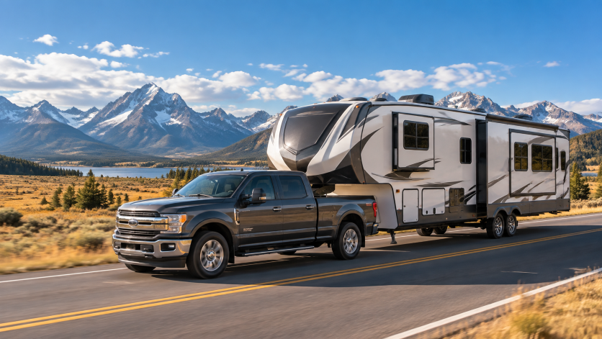
Here's what to compare:
Towing capacity of your vehicle against the RV's loaded weight, not just its dry weight
Payload capacity, which includes passengers, cargo in the truck, and the trailer's tongue or pin weight
Hitch type. Fifth wheels require a bed-mounted hitch, and larger travel trailers often need a weight-distribution hitch
Five passengers plus luggage and gear can eat up a surprising amount of payload before the trailer is even connected. Leave a safety margin, especially for towing over mountain passes. Use the Pierce RV towing capacity guide to look up your vehicle, and our team can help you match an RV to the truck or SUV you already own.
What Mistakes Do Families Make When Buying an RV?
The most common mistakes are buying too small, ignoring weight limits, and choosing a layout based on looks instead of how the family will actually use it.
Buying for today instead of the next five years. Kids grow, and what fits now may feel cramped soon.
Counting sleeping capacity instead of real beds. A "sleeps 8" unit might only have four comfortable spots.
Forgetting seat belts in a motorhome. Every passenger needs a belted seat while the RV is moving. Count seat belts before you count beds, and check which seats can accommodate child safety seats.
Overlooking the bathroom. Five people sharing one small wet bath adds up quickly on a rainy morning.
Skipping the walkthrough. Bring the whole family. Have everyone sit at the table, lie in their bunk, and move around the kitchen at the same time.
Underestimating towing needs. A trailer that's too heavy for your vehicle is unsafe and hard on your truck.
Ignoring service support. Choose a dealer with an on-site service department that can handle warranty work and repairs when you need it.
How Can Pierce RV Help Your Family Find the Right RV?
Pierce RV has locations in Billings and Great Falls, Montana, with new and used travel trailers, fifth wheels, toy haulers, and motorhomes from brands including Forest River, Keystone, Winnebago, Coachmen, Alliance RV, and Thor Motor Coach.
Here's how our team can help:
Compare floorplans in person. Walk through bunkhouse travel trailers, fifth wheels, and Class C motorhomes side by side.
Check towing compatibility so your RV matches your truck or SUV.
Explore financing. Apply for RV financing and plan a payment that works for your family.
Trade in your current RV. Get your RV trade-in value and put it toward a bigger unit.
Keep your RV ready. Our Billings RV service center and Great Falls service department handle maintenance, repairs, and warranty work, and our RV parts department stocks accessories and replacement parts.
Pierce RV serves families across Montana, including Bozeman, Helena, Missoula, Kalispell, and Havre, as well as neighboring Wyoming, North Dakota, South Dakota, and Idaho.
Frequently Asked Questions
Is a travel trailer or fifth wheel better for a family of 5?
A travel trailer is better if you want a lower price and a lighter unit that may work with your current vehicle. A fifth wheel is better if you camp often, take long trips, or want more living space and easier towing. Both come in bunkhouse floorplans. The right choice usually depends on your tow vehicle and how many nights a year you plan to camp.
What does "BH" mean in an RV model name?
"BH" in an RV model name typically stands for bunkhouse. It indicates the floorplan includes a separate bunk area, usually with two or more bunks, apart from the master bedroom. Bunkhouse layouts are popular with families because kids get their own sleeping space. Always check the actual floorplan, since bunk size and arrangement vary widely between models.
Can a family of 5 fit in a Class C motorhome?
Yes, many Class C motorhomes can fit a family of five. Look for a floorplan with a cab-over bunk, a rear bed, and a convertible dinette or sofa. The key detail is seating. Confirm the motorhome has at least five seat-belted positions for travel, and check which seats work with child safety seats. Sleeping capacity alone doesn't tell you how many people can ride safely.
Should a family buy a new or used RV?
A used RV can give a family more space and features for the same budget, and it avoids the steepest depreciation. A new RV offers full manufacturer warranties, the latest layouts, and a known history. Many families start with a used bunkhouse trailer to learn what they like, then upgrade later. Either way, have the unit inspected and review the floorplan with everyone who will use it.
How long should an RV be for a family of 5?
Most families of five are comfortable in a travel trailer or fifth wheel roughly in the upper-20 to mid-30-foot range, though layout matters more than length alone. A well-designed shorter bunkhouse can feel roomier than a longer unit with a poor floorplan. Keep campground site limits in mind too, since some older state and national park campgrounds have length restrictions.
Can kids ride in a travel trailer while it's being towed?
No. Passengers should not ride in a travel trailer or fifth wheel while it's moving. Towable RVs aren't designed with passenger seat belts or crash protection, and many states prohibit it. Everyone should ride in the tow vehicle with proper restraints. If you want the kids to have room to move during travel, a motorhome with enough belted seats is the better option.
What is the best RV for a large family on a budget?
A used bunkhouse travel trailer is usually the best budget option for a large family. It delivers dedicated kid sleeping space at a lower price than fifth wheels or motorhomes, and lighter models may work with a vehicle you already own. Focus on a solid floorplan, a sound roof and floor, and working appliances rather than extra features.
Final Takeaway
For most families of five, a bunkhouse travel trailer or bunkhouse fifth wheel is the best RV choice. Both give kids their own sleeping space and offer layouts that grow with your family. Class C motorhomes are the best drivable option, as long as they have enough seat belts for everyone. Focus on real sleeping spaces, towing compatibility, storage, and a layout your whole family can use comfortably.
Ready to find your family's RV? Browse our full RV inventory, see what's available at our Billings inventory or Great Falls inventory, or contact Pierce RV to schedule a family walkthrough. You can also call our Billings store at (406) 655-8000 or Great Falls at (406) 761-3520.
